
How an Earnings Gap Works: Solesence Closed Up 67% After Its Q3 Report
Solesence reported after the Nov. 12 close, and its stock went from $0.909 to $1.52 by the Nov. 13 close. The move shows how an earnings gap forms, partly fades in pre-market and then plays out on heavy volume.
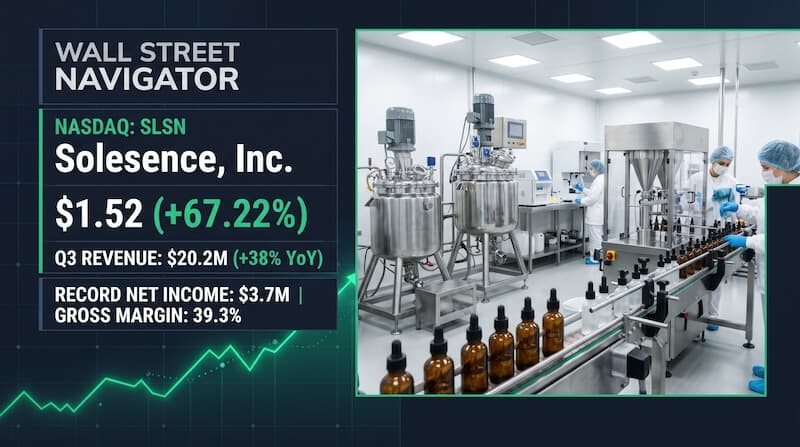
Solesence, Inc. (NASDAQ: SLSN) reported third-quarter results in an 8-K filing at 4:06 p.m. ET on Nov. 12, 2026, after the close. Revenue rose 38% to $20.2 million, and net income was $3.7 million, against a $1.0 million loss a year earlier. The stock closed the Nov. 13 session at $1.52, up 67.22% from Thursday's close of $0.909.
A margin turnaround that the stock repriced in stages
Gross margin rose to 39.3% from 23.8%, and the company swung to a profit. The price moved in steps: up in after-hours trading on Nov. 12, down in pre-market on Nov. 13, then sharply higher in the regular session. About 83% of the float traded on Nov. 13, a level of turnover that goes with a move this size. It is not clear how the results compared with analyst expectations.
How an earnings gap forms
A gap is the distance between one session's closing price and the next session's opening price. Many companies report after the 4:00 p.m. ET close, so the news arrives while the main market is shut. Pre-market (before 9:30 a.m. ET) and after-hours (after 4:00 p.m. ET) sessions do trade, but with fewer participants.
At 9:30 a.m. ET an opening auction collects buy and sell orders and sets one starting price. If the report changed what buyers will pay, that price lands away from the prior close. The distance depends on how results and guidance (the company's own forecast) compare with expectations.
Stocks with few shares available to trade can gap further, because fewer orders are needed to move the price. After the open, a gap can hold, extend or fade as regular-session volume arrives.
How Solesence traded from Nov. 12 to Nov. 13
- Nov. 12, after-hours: the stock ended at $1.27, up 39.73% from its $0.909 close. The filing came six minutes into the session, and the company had scheduled its conference call for 5:00 p.m. ET.
- Nov. 13, pre-market: the price was $1.17, down 7.88% from the after-hours close but 28.71% above the Nov. 12 close. The range ran from $1.05 to $1.35 on 563,507 shares.
- Nov. 13, regular session: the opening gap was 24.31% above the Nov. 12 close. The stock traded between $1.02 and $1.86 and closed at $1.52, up 29.91% from its pre-market close, on 15.82 million shares.
- Nov. 13, after-hours: the price slipped to $1.45, down 4.61% from the $1.52 close, on 1,168,282 shares. It ranged from $1.43 to $1.79.
The stretch before the report was calm. From Oct. 15 through Nov. 12 the stock gained 2.33%, with a period high of $0.9752 on Oct. 16 and a low of $0.7702 on Oct. 26. Its largest daily moves were a 6.76% rise on Nov. 4 and a 6.58% drop on Oct. 23. The Nov. 13 close was above that entire range.
A small float amplified the news
Solesence had a float (shares available for public trading) of 19.01 million, and its 10-day average volume was about 193,279 shares. The 15.82 million shares that traded in the Nov. 13 regular session equaled 83.2% of the float. With so few shares in public hands, new demand can move the price a long way, and the session's range from $1.02 to $1.86 shows how wide the swings were.
The report also gave buyers specific numbers to price: a profit in place of a loss, and gross profit that more than doubled from a year earlier.
What the quarter said about the business
The company's press release gave these third-quarter figures:
- Revenue: $20.2 million, versus $14.6 million in the third quarter of 2025.
- Gross profit: $7.9 million, versus $3.5 million.
- Gross margin: 39.3%, versus 23.8%.
- Net income: $3.7 million, or $0.05 per diluted share, versus a net loss of $1.0 million, or $0.01 per share.
The company said it was the highest quarterly net income in its history. CEO Kevin Cureton said Solesence had completed the primary investment and implementation phase of its operational excellence pillar, which he said raised capacity and efficiency. The company also said it expects at least $65 million in shipped and on-hand orders by year-end and sees potential longer-term EBITDA above 20%. EBITDA is earnings before interest, taxes, depreciation and amortization.
What comes next for the gap
- Nov. 16: the first regular session after the Nov. 13 after-hours close at $1.45.
- Year-end: the company's expectation of at least $65 million in shipped and on-hand orders.
- 2027: CFO Laura Riffner said the 2026 improvements provide a foundation for the year.
Bottom line
The Nov. 13 session shows a full gap cycle: news after the close, a first price in extended hours, a partial pullback in pre-market, and a regular session that traded from $1.02 to $1.86 before closing at $1.52. A small float and a sharp margin improvement fit the size of the move, and the slide to $1.45 after the close shows the price was still adjusting.
This article was processed by WSN Finance AI Analysis and prepared by WSN Editors based on financial analysis.
This article is for informational purposes only and is not investment advice.