
How Markets Price a Multi-Year Contract: ASTS and Its Blacklift Rocket Deal
AST SpaceMobile agreed to pay Firefly for rocket engines and a license over several years. ASTS closed up 7.05% from Thursday's close, a worked example of how traders weigh payments that stretch to 2028.
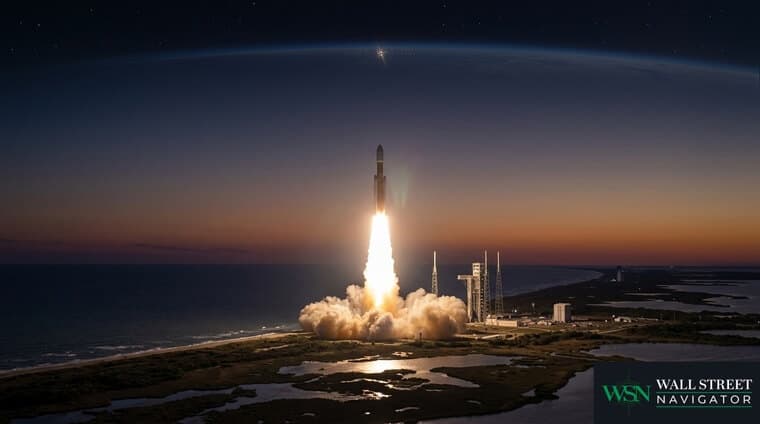
AST SpaceMobile, Inc. (NASDAQ: ASTS) said on Nov. 6, 2026 that it will build its own 20-ton rocket, named Blacklift, using engines from Firefly Aerospace (NASDAQ: FLY). The company filed the terms in a Regulation FD filing at 5:00 p.m. ET, and said it will pay about $800 million upfront for an engine license, plus separate payments for engines and services. Launches are planned to start in late 2028.
ASTS is the payer, and the shares still rose
Shares closed at $32.33, up 7.05% from Thursday's close, even though the deal commits ASTS to spend money before any launch. The company will pay in cash and in new stock, and the benefit depends on a rocket that is not due to fly until late 2028. The move also followed a 15.22% drop the day before.
How the market weighs payments spread over years
A large multi-year contract does not move a stock by its headline size. Traders ask who receives the money, when it arrives, what it costs to deliver, and whether it is paid in cash or in new shares. Money due years from now is worth less today, so the market discounts it. Payments in stock add shares and spread earnings across more owners (dilution).
Here the roles are reversed from the usual case. ASTS is the buyer, so the contract is a commitment to spend, and the possible payoff is cheaper, more reliable launches. Firefly is the side booking the revenue.
Shares dipped pre-market, then rallied in the regular session
ASTS had already gained 2.13% in after-hours trading on Thursday (the session after the 4:00 p.m. close), before the Friday news flow, so part of the early move predates the announcement. In pre-market trading (before the 9:30 a.m. open) it slipped 0.92% from that after-hours close to $30.56, on 2.75 million shares and 6.53 times its 10-day average volume.
The regular session was wider. Shares traded between $27.58 and $33.16 and closed at $32.33, up 5.79% from the pre-market close. Volume was 28.29 million shares, about 2.08 times the 10-day average. In after-hours trading the stock added 0.49% to $32.49.
The path into the news was steep. ASTS fell 15.22% on Thursday, its biggest one-day drop since Oct. 8, and closed at $30.20 after $35.62 on Wednesday. Over the period from Oct. 8 through Thursday, the shares lost 46.95%, from a high of $60.30 on Oct. 8.
What the terms say about the size of the commitment
According to the company, the payments break down this way:
- About $800 million upfront for the license: $400 million in cash plus 10 million to 14 million Class A shares, set by a forward volume-weighted average price (VWAP) calculation.
- $250 million for engines for the first three Blacklift rockets.
- $250 million over three years for engineering support services.
The final share count depends on the stock price, so the dilution is a range for now. For scale, ASTS has about 275.75 million shares in its float (shares available for public trading), and its market value was about $12.58 billion.
What the deal says about the company
ASTS said Blacklift completes its long-held plan to control the whole chain from satellite to launch. It will keep using outside launch providers, with agreements covering more than 100 BlueBird satellites between 2027 and 2028. Blacklift is designed to carry up to five BlueBird satellites per launch.
Company executives also pointed to markets beyond phone service, including government radar and secure communications. The company said its satellites are now in production through BlueBird 51.
Funding is a live issue. A securities class action filed in federal court in Texas, announced by the law firm on Nov. 5 at 9:21 p.m. ET, alleges ASTS understated how much capital it needed and how much debt and dilution would follow. It covers purchases from March 4, 2025 to July 15, 2026. The allegations are unproven.
What to watch next
- Nov. 12: ASTS hosts a Blacklift unveiling event in New York City, webcast on its investor relations site.
- Nov. 13: deadline for investors to ask the court to be named lead plaintiff in the class action.
- The final share count under the license, set by the forward VWAP calculation.
- Late 2028: the first planned Blacklift launches.
Bottom line
A multi-year contract is priced on timing, who pays and the form of payment, more than on the total. ASTS carries the upfront cost in cash and shares, and the payoff depends on a launch date more than two years away. The 7.05% gain came the day after a 15.22% drop, so the session's move cannot be read as a verdict on this filing alone.
This article was processed by WSN Finance AI Analysis and prepared by WSN Editors based on financial analysis.
This article is for informational purposes only and is not investment advice.